- My First Australian Offer
- Posts
- This is everything you need to land your First Australian Offer
This is everything you need to land your First Australian Offer
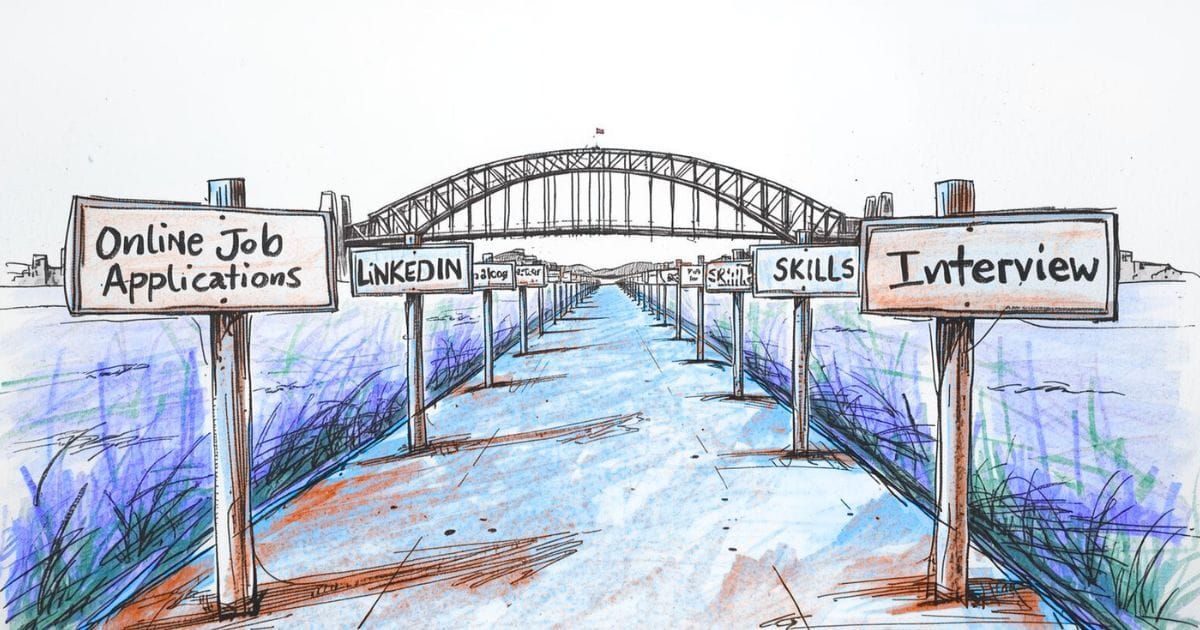
The most frequent job search advice I give: Online job applications, LinkedIn, Networking, Australian experience, and Interview Prep.

Utkarsh Manocha
December 10, 2025


2025 has been a terrible year for graduate and entry level jobs.
I met more than 1500 graduates and international students this year through our university workshops, My First Australian Offer community, and the clarity calls we received.
But the level of desperation, confusion, and helplessness in graduates trying to break into the Australian market, is something I haven’t seen before.
As we reach the end of the year, I want to give you a clear round up that sets you up to land a great role as soon as possible.
Inside, you’ll find answers to the questions I get every single week, along with the exact advice and resources we share with our students at My First Australian Offer that have helped them get hired.
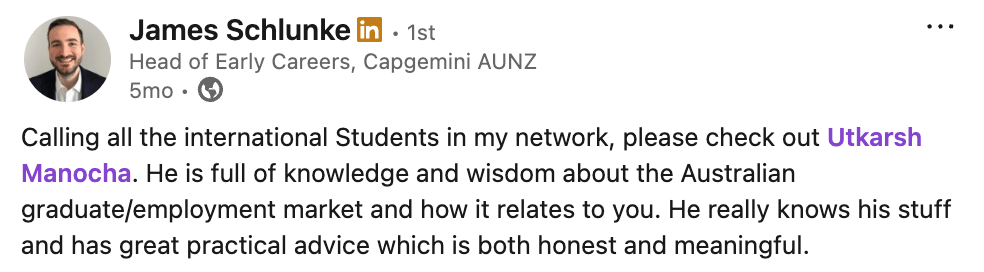
2 most common questions I get on LinkedIn
1. I’d love to connect and learn about any suitable opportunities or insights into the Australian job market.
I get this question daily.
Before I answer this, I have to tell you I’m not a huge fan of this message, and I don’t think it’s a great question to send to someone who doesn’t know you well.
Here’s why.
There is no clear way for me to answer it. I could reply with something generic like “The job market is good, Australia is a great place to build your career,” but that gives you nothing useful.
The real issue is that the question is too broad. It puts all the work on the other person. And in general if your message takes someone more than 2 minutes to respond to, the chances of them replying drop very quickly.
So the first shift you need to make is this. Be more specific with your questions, and think about what would make it easy for the other person to respond.
But if you do send me a message like this, this is what I’d share with you.
The job market is what it is and there’s no point stressing about it. It doesn’t matter whether you’re applying in October, November, December, January, or February.
It doesn’t matter whether you are on a student visa, a bridging visa, or a temporary graduate visa. It doesn’t matter whether the market feels hot or cold. At every point in time, people are getting hired in Australia.
The best thing you can do is focus on the parts of your job search you can actually control. The good news is:
There are only a few things that matter, so you only need to think about them.
- The quality of your online applications.
- The effort you put into maximising your LinkedIn profile visibility.
- The effort you put into networking.
- How well you prepare for interviews, including your communication skills.
- Your technical skills and how well they align with the roles you are targeting.
Everything outside of this is noise. It will only make you anxious.
2. I have applied for more than 200 jobs and haven’t received a single interview. How do I get past the ATS?
Before I answer this, I need to tell you something clearly. You have to stop obsessing over ATS. It’s not rejecting you. It’s not filtering you out. And it’s not the reason you aren’t getting interviews.
Think of an ATS as a Customer Relationship Management (CRM) system for recruiters. It is a database designed to organise applications, not to make hiring decisions.
So what about those rejection emails that look automated?
Those emails are sent through the ATS, but a human recruiter is the one who reviewed your application and decided that other candidates were a better match for the role.
The system just sends the template.
So write your application for a human, not an ATS. Repeating Python or Agile ten times won’t help you get shortlisted.
What will help is a clear, relevant, well-structured application that shows you are aligned with the role.
If you have been applying for roles for months with very little interest from employers, the first thing you need to do is take a step back to understand where the gap is. Until that gap is fixed, the rejections will continue.
There are 3 reasons I see international students get rejected most often:
- They are on a student visa and applying for full time roles.
- They do not have enough experience or technical projects that align with the roles they are targeting.
- They are writing poor online applications that are not getting seen.
So what do you do with this?
If you are on a student visa, focus on internships and graduate programs. That is where employers will consider you.
If you do not have any Australian experience, it becomes very hard to get a role. Most employers expect to see at least some experience on your resume, whether that is an internship, a university project, volunteering, or a part time project. They want to know you are culturally competent and can work in an Australian environment.
And if you have both of these in place but still haven’t received a single response, your next priority is to improve your online application. Fix that before you start thinking about LinkedIn, networking, or anything else.
Advice and Actionable recommendations on how to land your First Australian Offer
Over the last 3 years, I’ve written a ton of LinkedIn posts, Newsletters, and free content that go much deeper into the things we’ve just spoken about.
These are the pieces that have been featured in articles by LinkedIn, and reshared by recruiters and talent managers at some of the biggest companies in Australia.
I’ve linked my best ones below so you can read them at your own pace.
1. Job search strategy
When I moved to Australia, I arrived with the same expectations many international students still carry today. I assumed I’d be able to land a $100k job at a Big 4 right after my graduation.
But you realise soon enough that the reality here is different.
The Australian market works on its own timeline, its own rules, and its own definition of what experience looks like. The sooner you understand that, the faster your job search becomes.
So the first step is to set the right expectations for yourself. Take the time to understand the market you’re in, and build a strategy that’s aligned with your Candidate market fit.
That way you aren’t just targeting the roles you want, but there’s a balance between the jobs you want and the ones you are most likely to get.
2. Improving your online job applications
I lose my mind every time I hear someone say online job applications don’t work or that you “need” a referral to land a role in Australia. That’s simply not true.
At my First Australian Offer, the majority land a job through their online applications. For example, even in November 2025, out of the 7 people who were hired, 5 secured their roles strictly through online applications.
I’ve seen this trend consistently for three years. Between 68 and 70 percent of our international students get hired through online applications alone.
So before anything else, if you already have some kind of experience, whether that’s an internship, a university project, volunteering, or even experience from your home country, online applications are the most predictable way to get a job.
We need to figure out a way to write an application that shows you’re aligned with the role. You do that consistently multiple times and you’ll get a break through.
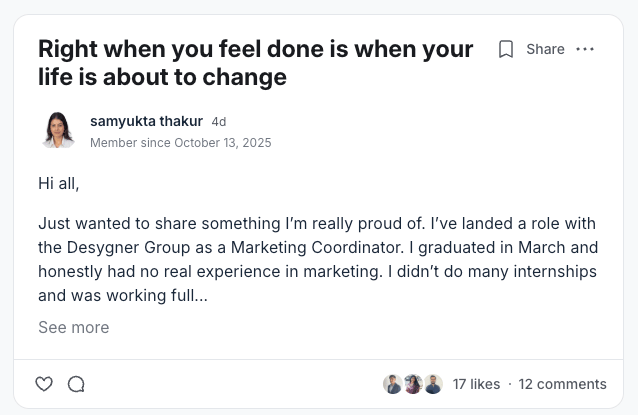
A story that popped in our community 4 days ago
3. Maximising your LinkedIn profile visibility
The best way to find a job is for a recruiter to find you. Many recruiters spend just as much time searching for candidates on LinkedIn as they do reading inbound applications.
So, one of the biggest advantages you can give yourself in the Australian job market is to make your LinkedIn profile easy to find.
Recruiters search for skills, titles, tools, industries, and experience. We want to ensure your profile is optimised so that it not only shows up in recruiter searches, but it shows up higher in their search results. The good news is you can control this.
4. Networking & cold out-reach
Networking isn’t just sending a couple of messages on LinkedIn and hoping someone replies. It’s also not forwarding the same ChatGPT message to everyone. That won’t move your job search forward.
For most students, cold outreach feels super awkward. Which is exactly why, if you push past that discomfort, reach out to the right people at the right companies, and learn how to write a strong cold email, you will stand out. Most people just never do it consistently enough for an extended period of time.
I recommend international students to reach out and network with three types of people:
People who are already accessible to you
People where you have already applied for roles, and;
Business owners, and Directors at SMBs that have previously hired people in similar profiles.
5. Interview Preparation
As someone who has done theatre in front of a 100 plus people, and even performed improv in random Sydney bars full of strangers, I have to tell you I find job interviews way more scary and awkward than performing in front of hundreds of people.
So yes it’s completely, absolutely, 100% fine if you feel nervous about an interview as well. In fact whenever someone tells me that, my first advice is don’t fight that feeling. The more you try to suppress it, the worse it becomes.
Yes, there are more interview formats today than ever before. Phone, video, panel, one-way interviews, case studies, and assessment centres.
But when I speak with graduate program managers and hiring leads from companies like Amazon, Capgemini, Deloitte, and others, one thing that always stands out is that interviewers today, are still asking themselves the same two questions they were asking 20 years ago.
Can this person actually do the job, and do it well? (Competence)
Would I want to work with this person every day? (Likability)
In the simplest of terms, our goal is to get 2 yeses to these two questions.

Utkarsh Manocha
That brings us to the end of this newsletter. I really ‘really’ hope you find these helpful and there’s a thing or two you can take from these to improve your job search.
If you do have any questions, please feel free to reach out to me.
Here’s how to stay in the loop:
Catch me on LinkedIn: That’s where I say the things I don't have room for in newsletters.
Share this with a friend who’d vibe with it.
If this landed in your inbox via a friend, subscribe here. It’s free, and I only send two a month. No spamming, pinky promise
Job hunting in Australia? Check out My First Australian Offer, it’s my job search program + community for grads, internationals, and anyone trying to get hired (and paid).
Want to collab or bring me in as a speaker? Just reach out here.