- My First Australian Offer
- Posts
- The Ultimate Interview Bible (Backed by 300+ offers)
The Ultimate Interview Bible (Backed by 300+ offers)
Part 2: Sample answers for behavioural questions, smart asks, and thank-you notes

Utkarsh Manocha
November 12, 2025
This is the second and the final part of our Ultimate Interview Bible.
Just like Part 1, this isn’t theory, it’s field-tested.
I use the same approach inside My First Australian Offer. It’s backed by over 500 mock interviews that have turned into 300+ real job offers (including 2 just yesterday).
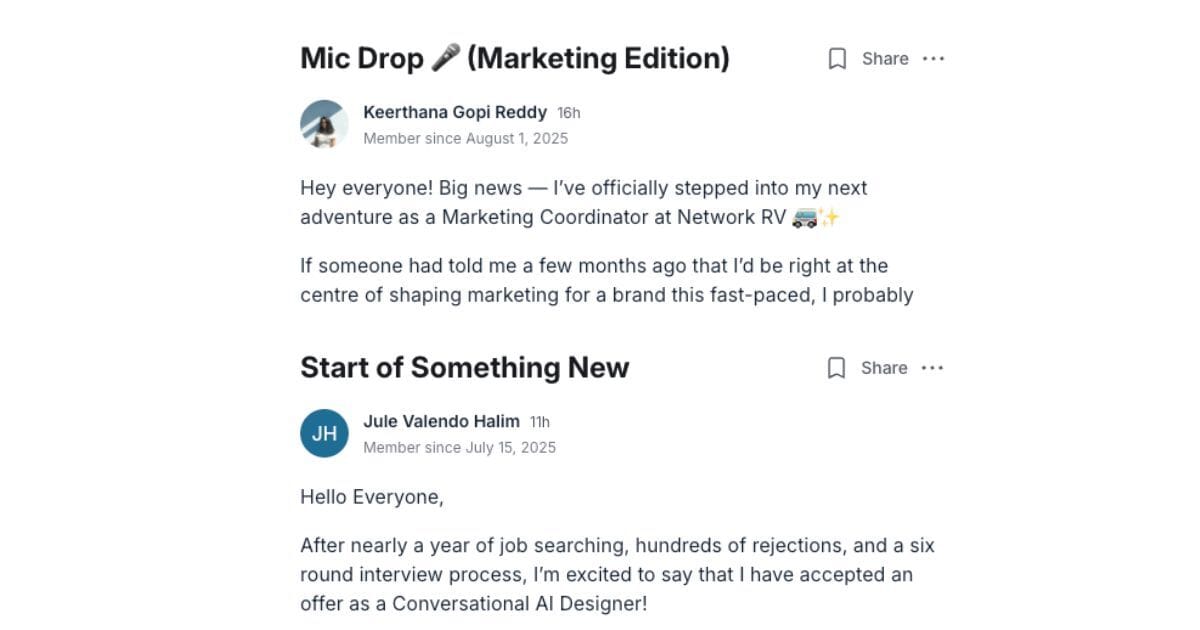
Screenshots from our community, My First Australian Offer.
Let’s get into it.
There are 6 core elements you need to get right if you want to convert your next interview into an offer:
First impression and small talk
Know the company inside out
Prepare for most frequently asked questions
Conquer behavioural questions
Ask insightful questions
Send a thank you note
We did a deep dive on the first three elements in Part 1. You can read that here.
Before we get into the remaining elements, here’s a quick word about our sponsors.
Feeling stuck about your next move in Australia? Whether it’s your visa, course, or PR pathway, Aussizz Group helps you find clarity.
They don’t just give visa advice; they build your roadmap, from student visa to PR, backed by experience, strategy, and genuine care.
For over a decade, Aussizz Group has guided thousands of students and professionals to make confident, informed decisions about their migration and education journey.
With over 40 offices globally and a strong presence in NSW with offices in Sydney, Parramatta, Bankstown, Macquarie Park, Rockdale, Wollongong, and Blacktown, they turn uncertainty into direction, and dreams into reality.
Use this link to book your free migration consultation.
Conquer Behavioural Interviews: The Real BS Test
Behavioural questions make up 60–70% of a typical interview.
It doesn’t matter if it’s a phone screen, a graduate program assessment centre, or a partner interview. Our rule of thumb stays the same:
Always expect behavioural questions, and be prepared for them.
These are the questions that ask you to share real examples of situations you have faced, and what decisions you made. For example:
Tell me about a time when you had to work with a difficult stakeholder
Describe a situation where you were managing multiple priorities
Walk us through an example where your initial approach didn’t work, and how you adapted.
They are popular because they are the real BS test.
Up until now, your resume has made a lot of claims about leadership, teamwork, problem solving, and adaptability, and the hiring team has politely taken your word for it.
But before they hire you, they want proof.
Behavioural questions help predict how you are likely to act in the future, based on how you’ve acted previously.
When it comes to students, graduates, and early professionals, here are the most common themes you need to be prepped for:
|
|
|
|
|
|
Why the STAR approach isn’t enough?
The go-to advice for answering behavioural questions is to follow the STAR approach.
I am not a huge fan of it because it makes for very poor storytelling.
Think about any great story: Harry Potter, Spiderman, Game of thrones (before the last 2 seasons)
In each and every one of them, there is a protagonist living their normal life (Situation), a villain appears who tries to make their life miserable (Challenge), the protagonist responds (Action), and then there’s a final resolution which in most cases is protagonist saving the world (Result).
You want to use this same storytelling approach in your behavioural answers.
There has to be a challenge, and you need to sell that challenge clearly, because if the challenge feels small, your solution will never sound as impressive.
I coach my students to build their example around the SCAR framework.
Situation: The specific context or background
Challenge: The challenge or obstacle you faced
Action: The specific steps you took to address it
Result: The positive outcome or what you learned
Tell us about a time when you were managing multiple priorities. How did you prioritise those talks and what was the result?
My role as a Consultant at Noetic was a typical fast-paced environment where I was often managing two to three client engagements at the same time. Earlier this year, I was leading a team for two NSW state government departments to help them migrate their systems and processes to Microsoft SharePoint. At the same time, I was supporting another project focused on governance and reporting frameworks. I was already at full capacity when a major bid opportunity came in.
This bid was for a high-value engagement with a client I had previously supported. Because I had in-depth knowledge of their operations and had delivered a similar project before, I was asked to lead the bid response. The biggest challenge was that the proposal had a one-week turnaround, and required input from multiple stakeholders, a couple of whom were known for not responding in time. On top of that, my existing client projects still had strict deadlines as well.
To manage this, I first mapped out every deliverable across all three projects and assessed my effort against impact. The goal was to identify high-priority tasks such as client workshops and the bid narrative. These were non-negotiables that required my direct focus.
Next, I delegated internal documentation and routine updates to analysts who could work independently and held short morning check-ins to stay aligned and remove any blockers early.
For the bid, since it involved multiple stakeholders, I asked my Director for support. I drafted an email for him to send to stakeholders explaining that I’d be reaching out and requesting their responses within 48 hours. This created accountability and ensured quick turnarounds.
We ended up submitting the bid before the deadline, and it was later selected as the winning proposal, securing a $1.5 million contract. Along with that, both my ongoing projects stayed on schedule as well. In this situation, I believe what made the difference was having clarity on priorities, delegating effectively, and maintaining strong communication. It was very satisfying to see how well we performed as a team despite competing demands.
The reason this is a strong answer is because it goes beyond just showing that you can manage multiple priorities.
It highlights that you’ve worked with government clients, led teams, written high-value project proposals, managed stakeholders, and delegated effectively. In a single story, you’re not only demonstrating time management and prioritisation, but also leadership, communication, and business development skills.
That’s what makes this powerful. It shows depth, range, and impact, which is exactly the kind of profile employers want to hire.
If you want to do well in behavioural interviews, my advice is to come up with stories around each of the 6 themes I have highlighted above. But don’t, don’t and please don’t memorise them word for word.
The Interview Reversal: Your Turn to Ask Questions
1 thing that stays the same regardless of the industry, the role, or even the country you are interviewing in, is how every interview ends.
It always ends with the interviewer asking you, “Do you have any questions for us?”
According to Qureos, 38% of candidates fail their interviews because they don’t ask good questions. That’s an outrageous statistic, especially when you think about it.
This is the one question we know is coming, yet so many people freeze, ask something generic they could have easily found online, or worse, say they don’t have any questions at all.
That cannot happen.
Before we talk about the kinds of questions you should ask, here are the questions you should stay away from, especially if you’re in the early career stage and are looking for your first Australian offer.
Avoid questions about salary and benefits too early. These conversations should happen only after you’ve progressed further in the process or once an offer is on the table.
Avoid questions that can be easily answered through basic research. Things like “What does your company do?” or “Where are your offices located?” show that you haven’t taken the time to prepare.
Avoid questions that are entirely focused on what the company can do for you. Instead of asking about training programs, promotions, or flexibility right away, focus first on understanding the team’s priorities and how you can add value.
So, what should you ask instead?
I like to think of questions in two buckets:
Bucket 1: Exceptional questions
Exceptional questions are the ones that come up naturally in the moment. The interviewer says something, and based on that, you ask a follow-up question. These cannot be fully prepared beforehand, which is exactly why they work so well. They turn the interview into a real conversation.
There are no shortcuts or cheat codes here. Just listen carefully and ask something thoughtful based on what the interviewer says, whether it is during small talk at the start or while they are describing the projects and responsibilities.
Bucket 2: Everything else (still good!)
The second category includes questions you can prepare ahead of time about the company and the role itself. For example:
What would you consider exceptional performance in this role during the first 90 days?”
The position description mentioned several key skills including [mention some of the skills]. From your perspective, which two are the most important for someone to succeed in this role?
Can you share a bit more about the most important priorities I would be focusing on in this position?
The reason I like these questions is because these show curiosity, preparation, and a genuine interest in doing the job well, not just getting it.
If you are unable to come up with any questions, use 1-2 of these in your interview, and close it with:
What are the next steps in the interview process, and is there anything else I can provide to help you make your decision?
The Science and Sense of Sending a Thank You Email
Before we even get into this, let me just say I spent hours digging through research and couldn’t find a single peer-reviewed study that proves sending a thank-you note directly increases your chances of getting hired.
Do a quick search, you’ll find this stat floating around LinkedIn:
68% of hiring managers say a thank-you message influences their decision, and 20% have even rejected candidates who didn’t send one.
Now, is that hard science? No.
But it tells us something important when you pair it with what dozens of psychology studies say about gratitude.
People who express gratitude are consistently rated as warmer, more likable, and more trustworthy. They build stronger relationships and others are more willing to help them in the future.
That’s exactly why I strongly recommend sending a thank-you email after your interview.
Here’s how to get it right:
Timing: Send it within 24 hours after your interview. That shows promptness without appearing overeager.
Best time of day: Aim for between 5–6 PM the same day, or first thing the next morning (7–8 AM) so it lands at the top of their inbox.
Panel interviews: Whenever possible, send individual emails to each interviewer instead of a group message.
Tone: Don’t write like a robot. A bad thank-you email can do more harm than good. So, if you’re planning to ask ChatGPT to write it, don’t send it.
Subject: Thank you for the Marketing Assistant interview
Hi Sarah,
Thanks for taking the time to speak with me today. I really enjoyed hearing about your new fundraising campaign and how UniMelb is using student surveys to shape it.
That part of the conversation stood out because of my own experience working on campaign presentations, and it was great to hear how creatively your team approaches it.
I’m incredibly excited about this opportunity. Please let me know if there’s any additional details you need from me.
Best,
Utkarsh

Utkarsh Manocha
That brings us to the end of this newsletter, and the 2nd part of our Ultimate Interview Bible.
Your first Australian offer is only a few months away from you. Reach out if you need any help with your interview prep.
Here’s how to stay in the loop:
Catch me on LinkedIn: It's where I say the things I don't have room for in newsletters.
Share this with a friend who’d vibe with it.
If this landed in your inbox via a friend, subscribe here. It’s free, and I only send two a month. No spamming, pinky promise
Job hunting in Australia? Check out My First Australian Offer, it’s my job search program + community for grads, internationals, and anyone trying to get hired (and paid).
Want to collab or bring me in as a speaker? Just reach out here.