- My First Australian Offer
- Posts
- The KPMG Graduate Program Playbook (2026 edition)
The KPMG Graduate Program Playbook (2026 edition)
The Ultimate guide on how to apply for the KPMG graduate program

Utkarsh Manocha
February 19, 2026


KPMG Australia received 32,000 graduate applications last year.
Not 32,000 clicks. Not 32,000 half-finished forms.
Thirty-two thousand applications that cleared the online assessments.
Which means every one of them met the baseline.
From there, resumes were reviewed. Service lines made cuts, and shortlisted applicants were invited to assessment centres.
What’s surprising isn’t that many people couldn’t clear the online assessment.
It’s that many strong candidates cleared it, but still weren’t shortlisted because they didn’t take the application questions seriously.
This step-by-step playbook exists to help you submit a better grad program application so that you get in.
Before we dive further, I want to clarify that this newsletter is not sponsored by KPMG, nor is it endorsed by anyone working there. The thoughts and recommendations are mine alone.
Let’s get into it!
The 2 unwritten rules of every job application
Before we talk about KPMG specifically, there are two principles that apply to every online application, regardless of company or industry.
Apply as early as you possibly can.
Make the reviewer’s life as easy as you possibly can.
Everything else builds on these.
1) Apply Early
KPMG applications close on 10th March 2026.
A lot of candidates will treat that as their target date.
That’s a mistake.
Applications are reviewed, assessed, and shortlisted while the window is still open. Decisions start forming long before the official closing date.
Early applicants always have an advantage. Not because they are better, but because they are seen sooner, assessed sooner, and considered while there’s more flexibility in the shortlist.
So the first rule of thumb: apply as early as you can.
2) Make the reviewer’s life easy
On the other side of your application is a human being reviewing it, alongside hundreds of others.
If they have to pause to understand what you studied, what your experience actually involved, or which division you’re genuinely suited for, you are creating friction.
Your job is to remove that ambiguity.
Be specific about your preferences.
Be clear about which division is your first preference.
Be intentional about location.
“Open to everything” is not a strategy. It’s just friction.
Quick Proof This Works
My First Australian Offer is a personalised job search coaching program and peer support community for students and early career professionals who want to start or level up their career in Australia.
In January, we had 7 people who landed amazing jobs. You can head over to the website to see their stories.
Here’s a breakdown of how they landed a role:
4 through online applications.
2 because a recruiter reached out to them on LinkedIn.
1 through a referral from someone they knew.
Since we started this community in 2022, most of our success stories have come from online applications. It’s usually because of 4 things:
– The application is tightly aligned to the role
– There’s clear Australian experience and local projects
– These applications were submitted early
– The recruiter finds the resume easy to scan and understand
Now, let’s get back to KPMG.
How to answer the application questions
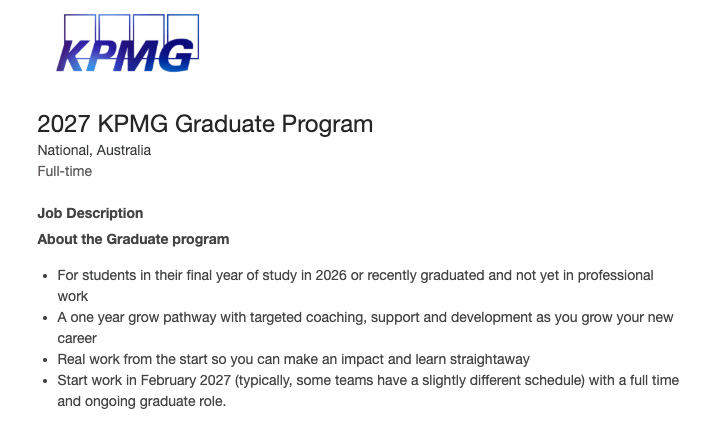
The KPMG application process is very straightforward.
Technically, you can complete this in less than 5 minutes. Practically, you shouldn’t do that.
As soon as you begin the application, you’re given the option to use your Seek or your LinkedIn profile to auto-fill your details. If you choose this option, your personal information, experience, and education section will automatically populate.
That’s convenient, but again, it’s not something you should blindly trust.
Go through each section, and verify that everything has transferred correctly.
The next step involves uploading your resume. In most cases, the system will automatically pull the version attached to your Seek or LinkedIn profile, but this is where you need to slow down.
Just stick with me on the resume part for a bit. We will shift gears and move to the second page of the application, and then I’ll jump back onto the resume part and answer that for you.
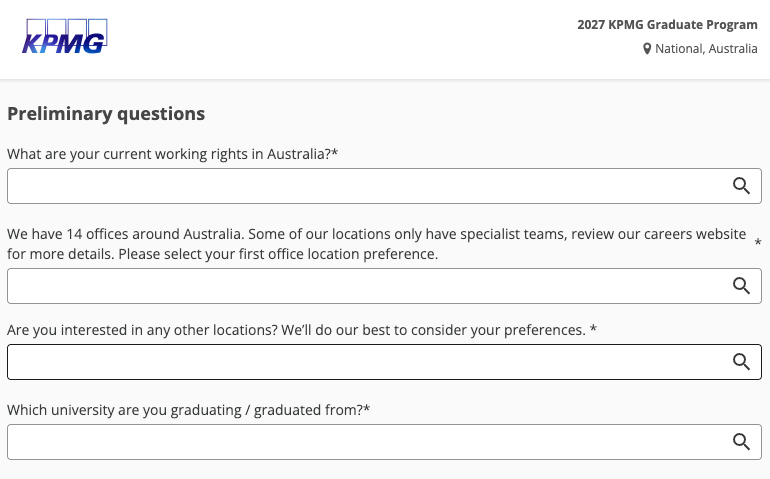
On the second page of your application, you’ll find over 20 preliminary questions. Out of all these, these are the most important ones where you can give yourself a strategic advantage:
1) Location
We have 14 offices around Australia. Some of our locations only have specialist teams, review our careers website for more details. Please select your first office location preference.
Are you interested in any other locations? We’ll do our best to consider your preferences.
2) Career Pathway Preference
Which career pathway is your first preference?
Within “this career pathway”, choose a segment preference that aligns with your interests. We'll consider this during our shortlisting process.
Within “this career pathway”, choose your second segment preference.
3) Additional Pathway Preference
Are there any other career pathways you’re interested in?
Are you interested in any other segments, even outside the pathway you’re applying for?
4) Division Preference
If you are interested in a particular Division at KPMG, please select here. We'll consider this during our shortlisting process.
Are you interested in any other Divisions at KPMG?
5) Team Preference
If there’s a particular team you’re excited about, you can paste the team name below
Let’s get into each of them now.
1.Location
This section has a dropdown with all the locations where KPMG has an office. You can select whichever city you would like to work in, and you can also select interstate locations.
The main thing you need to be careful about is this: if your application progresses, you will need to attend the assessment centre in person at that location. That is not at the company’s expense.
So be realistic.
The second point, which I think is a very smart move, is to consider selecting a regional location within your state.
Recruiters often find it harder to fill roles in regional offices. Naturally, competition there is lower compared to cities like Sydney, Melbourne, and Brisbane, both from domestic and international candidates.
For example, if I were applying in NSW, my strategy would be to select Sydney or Parramatta as one option, and then Newcastle or Wollongong as another.
The only thing you must ensure is that the career pathway you are selecting, which we’ll discuss next, actually exists in your chosen location. Not every division operates in every office.
2. & 3. Career Pathway & Additional Career Pathway Preference
This is where things really get interesting, and where your research comes in.
You’ve got 4 options:
Audit, Corporate Finance & Assurance
Business, Consulting, Risk & ESG
Tax & Legal
Engineering, Digital & Technology
If you remember, I had asked you to not worry too much about finalising your resume earlier. This is the exact reason why.
Before tailoring anything, you need clarity on which pathway you’re targeting.
KPMG has provided a ton of information about each of these pathways on their graduate careers page.
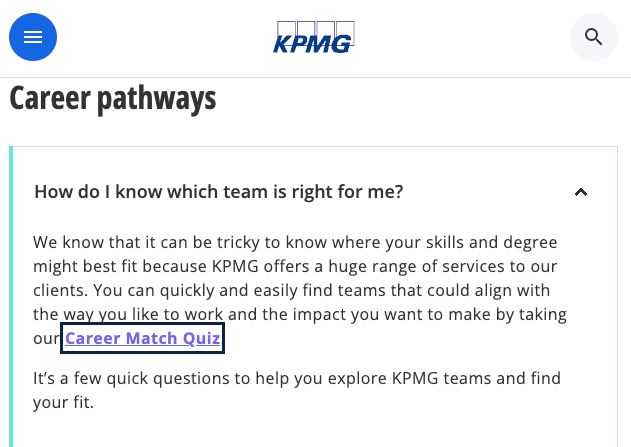
Under the FAQ section, they’ve included a Career Match Quiz specifically designed to help applicants determine which pathway might suit them best.
Read this before selecting a pathway.
Once you’ve selected a pathway, the application will then ask you to choose a segment preference within that pathway.
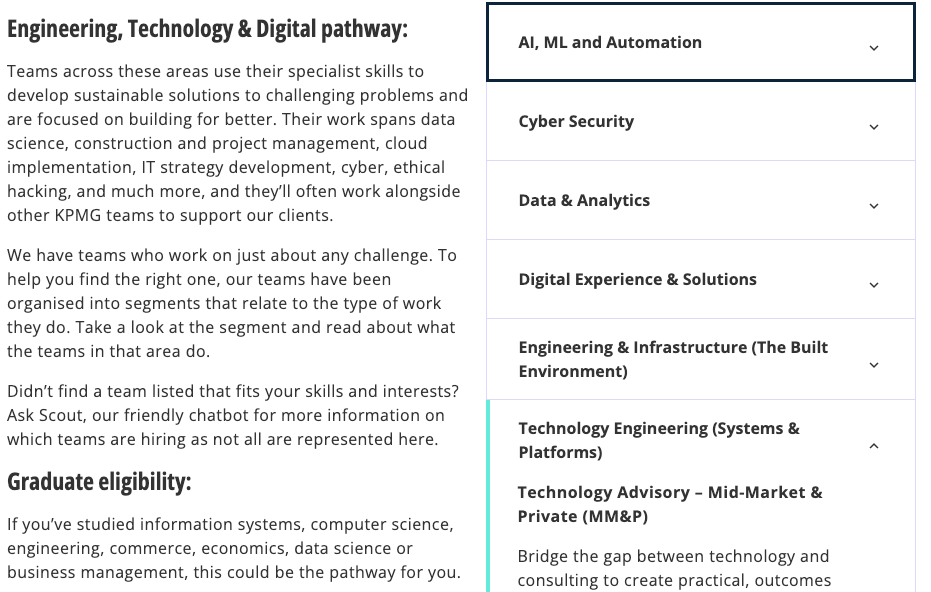
Each segment clearly outlines what they do, their preferred degrees, and the locations they operate in.
Your choice here must align with what you have studied, the experience you’ve had so far, and the projects you plan to highlight in your application. Everything should tell a consistent story.
At every stage, you are trying to make the matching process easier for the recruiter.
Although the form gives you the option to select “No preference,” I would strongly recommend not doing that.
By stating a clear preference, you reduce ambiguity. You help the recruiter quickly understand where you fit and make it easier for them to forward your application to the relevant division.
4. & 5. Division & Team Preference
The same principle applies here. Refer back to the resources we’ve discussed above, do your research, and state your preference.
How to structure your resume?
KPMG doesn’t require a one-page resume. Their guidance is that it should be no more than two pages. That means one page is fine. One and a half pages is fine. Two pages is fine.
Every section of your resume should reinforce the pathway and segment you selected earlier. Here’s the structure I recommend:
1. Highlights or Summary Section
Start with a short Highlights or Summary section tailored to the pathway you’ve chosen.
The recruiter should understand what you are targeting and why you make sense for it.
For example, if you’re applying to the Data & Analytics segment within Engineering, Digital & Technology, this section should summarise your exposure to data work in a structured way.
How much hands-on experience do you have solving data-related problems? That includes university projects, internships, side projects, volunteering, and part-time roles.
What types of organisations or industries have you worked with? Corporate clients during internships. Simulated clients in consulting projects. Startups you supported. Independent datasets you analysed.
What kinds of problems have you worked on? Cleaning and transforming raw data. Building dashboards. Performing statistical analysis. Automating reports. Developing predictive models.
Immediately below this, include a clear Skills section listing your hard skills. Tools, software, programming languages, and analytical methods should directly reflect the pathway you selected.
2. Education
List your degree, university, and expected graduation date. Include academic achievements if they are strong and relevant.
More importantly, highlight 2-3 courses that support your chosen pathway.
If you are applying to Audit, mention Financial Accounting, Auditing, or Taxation.
If you are applying to Consulting, mention Strategy, Operations, or Business Analytics.
If you are applying to Data & Analytics, mention Statistics, Machine Learning, or Database Systems.
3. Experience
List your experience in reverse chronological order.
Include internships, part-time roles, overseas experience, and any professional exposure that adds value to your application.
Graduate programs assess more than technical ability. They assess maturity, communication, accountability, and adaptability.
If you have worked in retail, hospitality, or customer service, include it. Those roles demonstrate stakeholder interaction, teamwork, and for international students, Australian workplace exposure.
For each role, avoid listing duties and focus on impact.
What problem were you responsible for?
What actions did you take?
What changed as a result?
Even in non-technical roles, highlight outcomes and transferable skills that align with the pathway you selected.
4. Notable Projects
Include university projects, capstone assignments, consulting simulations, research work, or independent builds in your resume.
They are proof of applied capability.
5. Certifications (if relevant)
There is no need to list every online course you have completed.
If a certification strengthens your positioning for the selected pathway, include it. If it does not materially support your application, leave it out.

Utkarsh Manocha
That brings us to the end of this playbook, folks.
All the best for your KPMG Grad Program Application. I really hope you do get this role.
Here’s how to stay in the loop:
Catch me on LinkedIn: It's where I say the things I don't have room for in newsletters.
Share this with a friend who’d vibe with it.
If this landed in your inbox via a friend, subscribe here. It’s free, and I only send two a month. No spamming, pinky promise
Job hunting in Australia? Check out My First Australian Offer, it’s my job search program + community for grads, internationals, and anyone trying to get hired (and paid).
Want to collab or bring me in as a speaker? Just reach out here.