- My First Australian Offer
- Posts
- How to use LinkedIn to land your First Australian Offer
How to use LinkedIn to land your First Australian Offer
Transforming your LinkedIn profile into an interview magnet

Utkarsh Manocha
March 05, 2026

For the last three years, I’ve been a LinkedIn Top Voice.
During this time, I’ve been invited by the LinkedIn team to speak on panels. I’ve delivered LinkedIn workshops.
I’ve used LinkedIn to land a job myself, and I’ve also helped many graduates do the same through My First Australian Offer.
All that to say, yes, I do know a thing or two about how LinkedIn works.
In this newsletter, I’ll break down:
The two key concepts that determine your LinkedIn visibility
Building a profile that’ll impress decision makers when they visit it, and;
How to get decision-makers to discover your profile in the first place
Let’s get into it.
The two concepts that determine your LinkedIn visibility
LinkedIn is not a job board.
It’s a professional networking platform that also happens to have a job board.
These are two very different things.
If your goal is to land a job through LinkedIn as quickly as possible, relying only on applications won’t help you do that. There are two other ways LinkedIn helps people get hired:
Getting discovered by recruiters and hiring managers
Getting support from your network
Both of these can dramatically increase your chances of landing interviews.
In this section, we’re focusing on how to get discovered by recruiters and hiring managers.
Recruiters actively use LinkedIn to search for candidates.
Just like you search for “best pizza places” on Google, recruiters run searches for data analysts, marketing coordinators, civil engineers, finance officers, AI engineers, and many other roles on LinkedIn every single day.
And just like you rarely go to a restaurant that appears on page 10 of your search results, recruiters also focus on the profiles that appear at the top of their searches first.
A quick example.
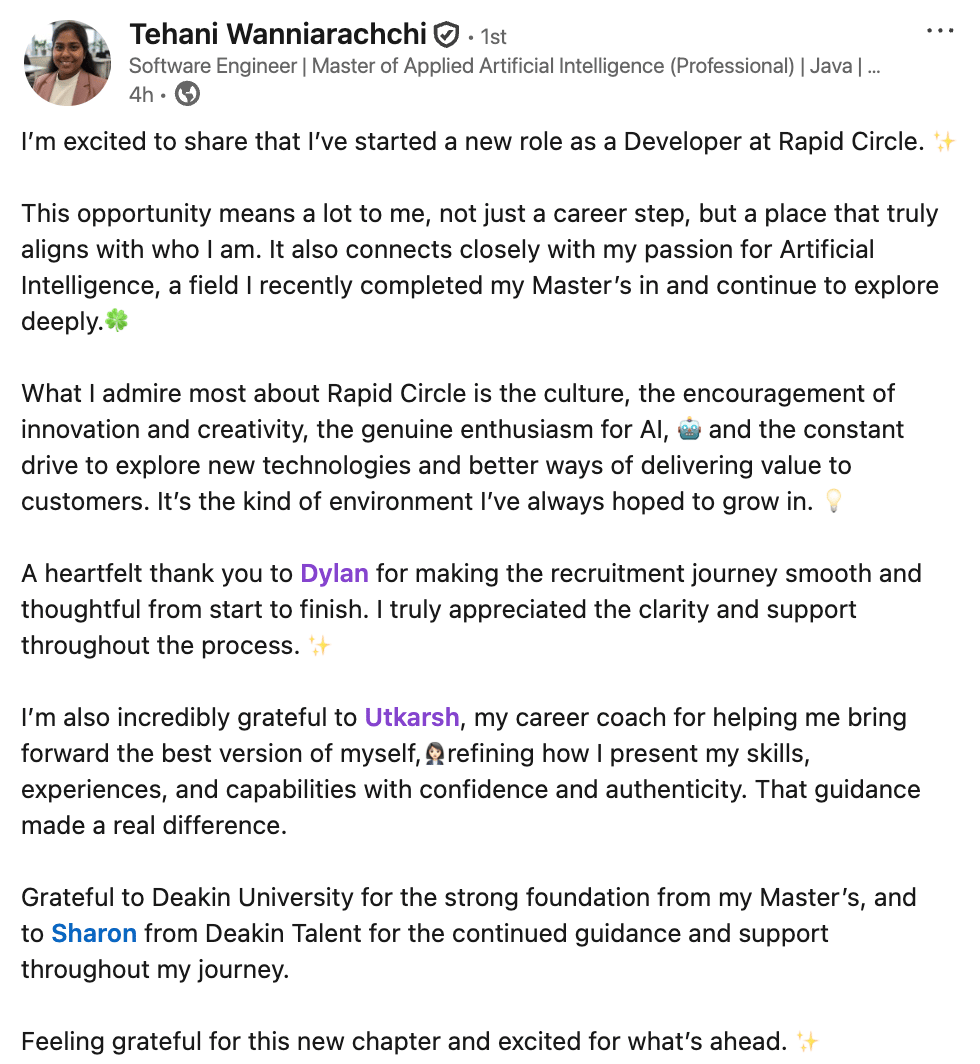
Tehani recently landed her first Australian offer in software development, but she never applied for this role on Seek or LinkedIn.
A recruiter came across her LinkedIn profile while searching for candidates. He probably thought her profile was a good fit and asked for her resume. He liked what he saw, and that’s what led to an interview.
It’s very possible if Tehani hadn’t put the effort she did to maximise her LinkedIn visibility, she’d have never landed this opportunity.
So what determines whether your profile appears in recruiter searches?
There are two key concepts:
Keyword optimisation
Keyword optimisation simply means including the right keywords on your LinkedIn profile.
Recruiters search LinkedIn using job titles and skills.
If you are targeting data analyst roles, recruiters will search for things like data analyst, SQL, Power BI, Python, dashboards, and similar terms.
If you are targeting marketing coordinator roles, they might search for marketing coordinator, digital marketing, campaign management, SEO, and related skills.
If your profile does not include those keywords, LinkedIn has no way of showing your profile in those searches.
So the first rule is simple:
Your profile needs to include the keywords recruiters are searching for.
Keyword density
Keyword density is about how often those keywords appear across your profile.
It’s not enough to mention a keyword once.
LinkedIn’s search algorithm looks at how consistently those keywords appear across different sections of your profile.
For example, if you are a software developer, it’s not enough to just write Software Developer in your headline.
Those keywords should appear across multiple sections of your profile, including your:
Headline
About section
Experience
Skills
Education
Projects
LinkedIn Posts
If your profile includes terms like software developer, Java, C#, backend development, APIs, and AI across multiple sections, LinkedIn is more likely to recognise your profile as relevant when recruiters run those searches.
The more clearly and consistently your profile reflects those keywords, the higher the chances that your profile appears in recruiter searches.
Building a profile that’ll impress decision-makers when they land on it
Anyone who visits your profile will only spend a few seconds scanning it, before they decide whether they want to speak with you or not.
Your job is to ensure they quickly understand:
What you do
What skills you have
What experience or projects you’ve worked on
Whether you are worth speaking to
To make that happen, your profile needs to be complete and well structured from top to bottom.
LinkedIn gives you a number of sections to showcase your background. The more relevant information you provide in these sections, the easier it becomes for someone to evaluate your profile.
From top to bottom, these are the key sections decision-makers usually look at:
Cover photo
Profile picture
Headline
About section
Featured section
Activity
Experience
Education
Licences and certifications
Projects
Volunteering
Skills
Recommendations
Honours and awards
The goal is simple.
Populate as many of these sections as possible with relevant information.
Many people make the mistake of leaving large parts of their LinkedIn profile empty.
For example, in the experience section, people often just list the company name and job title. That doesn’t tell anyone what you actually did.
At a minimum, the same bullet points you include in your resume should also appear under your LinkedIn experience.
Similarly, they don’t highlight the projects they completed at university.
If you built a dashboard, created a marketing campaign plan, analysed a dataset, or developed software as part of a class project, those things absolutely belong on your LinkedIn profile.
Projects help decision makers understand what you are capable of doing, and they also strengthen your keywords, which improves your visibility in searches.
The same applies to volunteering, certifications, skills, and recommendations.
Each section gives you another opportunity to communicate what you’ve done and what you’re capable of doing.
Getting decision-makers to notice your profile
You can have an amazing website. But if nobody is visiting that website, nobody knows how good it is.
The same applies to your LinkedIn profile.
You might have a well-written About section, strong projects, solid experience, and a well-optimised profile. But until people actually visit your profile, all of that work won’t make much difference.
Your LinkedIn profile needs traffic.
There are three ways to drive decision-makers to your profile:
Reaching out directly through DMs
Commenting on posts written by industry professionals
Posting content yourself
All three approaches can work, but in this newsletter we’ll focus on 2 and 3, because they are the most scalable ways to increase your visibility on LinkedIn.
Commenting on relevant posts
One of the simplest ways to increase your visibility on LinkedIn is by leaving thoughtful comments on other people’s posts.
But the key here is commenting under the right people.
If you are a marketing graduate, you should be following and engaging with posts written by:
Marketing managers
Marketing directors
Marketing analysts
Founders of small businesses
Companies in your industry
When you leave comments under posts written by these people, your profile becomes visible to them and to others reading the conversation.
Many job seekers make the mistake of commenting primarily on posts written by other job seekers.
While that may feel supportive, it does very little to improve your visibility with decision makers.
Your goal should be to be present in conversations where industry professionals are already active.
The second important rule is that your comments need to add value.
Instead of writing something generic like “Great post!”, try to:
Add an insight
Share a small observation
Expand on the idea being discussed
Ask a thoughtful question
For example, if a company like Deloitte publishes a post, leaving a thoughtful comment can make your profile visible not only to the author of that post, but also to hiring managers and professionals who are following that discussion.
This can be even more powerful when you engage with posts from small and medium businesses or founders, because those individuals are often directly involved in hiring.
In our community, we’ve seen numerous examples where students built relationships with founders simply by consistently adding thoughtful comments under their posts.
Writing posts on LinkedIn
The second way to increase your visibility is posting content on LinkedIn.
Posting helps your profile reach more people beyond your immediate network.
But before you do that, you need to understand who’s your audience.
For example, my audience primarily consists of university students, graduates, and internationals looking for their first Australian job. But if you are a job seeker, your audience is different.
Your audience is:
Recruiters
Hiring managers
Small and medium business owners
Industry professionals
You should want these people to be reading your posts, so the content needs to be relevant to them.
Instead of posting about your job search struggles, focus on sharing things that demonstrate your competence and interest in the field.
For example, you could post about:
A project you recently completed
A portfolio piece you built
An industry article you found interesting and your perspective on it
An event or webinar you attended and what you learned
A lesson from an internship or work experience
A technical concept or tool you are learning
The goal of your content is to signal you are someone who understands the industry and is actively working on their craft.
When decision makers see posts like these, it often leads them to click on your profile to learn more about you.
When that happens, your LinkedIn profile becomes more than just a static page.
It becomes a platform where opportunities can find you.
Here are a few types of posts where this works particularly well:

Utkarsh Manocha
That brings us to the end of this newsletter, folks. I’ll see you next fortnight. All the best for your job search.
Until then, here’s how to stay in the loop:
Catch me on LinkedIn: It's where I say the things I don't have room for in newsletters.
Share this with a friend who’d vibe with it.
If this landed in your inbox via a friend, subscribe here. It’s free, and I only send two a month. No spamming, pinky promise
Job hunting in Australia? Check out My First Australian Offer, it’s my job search program + community for grads, internationals, and anyone trying to get hired (and paid).
Want to collab or bring me in as a speaker? Just reach out here.